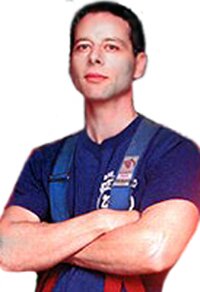
What a Firefighter Needs Strength + Endurance = Performance
Panicked occupants sat perched at every window, as dense, black smoke pushed them to sill's edge. We couldn't rip the bulky ladders from the rigs fast enough, but thank God, every man, woman, and child pouring from the tenement's brick facade was miraculously plucked to safety.
I'll never forget the mass effort that went into that day's rescue. Every firefighter on scene went above and beyond, pouring their last shred of strength into beating back that raging inferno. Dozens were delivered to safety before the firefighters themselves collapsed from pure exhaustion.
Workout to extend work capacity and operate more efficiently on the fireground. Find out how: click here
JOB REQUIREMENTS
Typical fire department, hand-held portable ladders can out-weight the rescuer, and extend up to a top-heavy 35 feet (three stories) in length. When in full extension this represents a substantial load that's hard to control, especially when distraught occupants are grabbing for the tip. And that's before climbing the ladder and possibly carrying down an injured or unconscious victim.
Hand-held high-pressure hose lines can pump out over 200 gallons of water per minute, and backpressure can be severe (up to 250 PSI). It takes two powerful individuals to control one line. What is in essence a giant water gun (bazooka might be more appropriate) must be advanced and operated simultaneously, no easy feat when crouched down below high heat.
Typical residential apartment door feature multiple locks and are very often made of steel. Hydraulic forcible entry tools are not to be relied upon, as every firefighter must posses the know-how AND explosive force to pry open locked doors by hand. Skill, as well as brute strength, is a major asset.
TYPICAL FIREFIGHTER TASKS
· Handling / raising heavy ladders
· Rescue and removal of trapped victims
· Advancing high pressure hose lines
· Forcible entry operations
· Overhaul / removal of walls and ceilings
· Hauling heavy hose and equipment
· Operating with 50 lbs of thermal protective gear
By taking a quick look at the typical tasks it's easy to see why strength AND endurance must go hand in hand. Having the brute strength to lift the heaviest ladder one or two times would be of little help to the trapped occupant at window three. But strength is necessary, strength that endures!
The body must strike a balance between strength and endurance. As firefighters, we NEED a good measure of both. Kettlebell Lifting and my system of STS Training are superior methods that build this seemingly elusive quality of strength / endurance.
ASK YOURSELF
What builds strength? Lifting a heavy weight a few times. What builds endurance? Lifting a light weight many times. So, what's the best way to build strength/endurance (one word)? Lifting a moderate weight many times. And one last question; what builds the extreme strength/endurance a firefighter needs? Lifting a moderate weight, many, many times!
Timed sets, featured in both Kettlebell Lifting and my STS Training (for those with no access to kettlebells), satisfy the exact formula a firefighter needs to excel on the fireground. As an added bonus to the strength, endurance, power and explosiveness developed with this type of training, intra-muscluar and abdominal fat loss accelerates due to the body's increased ability to utiize fat as its primary fuel (mitochondrial increase).
Stop floundering in the gym performing endless low rep sets of bicep curls. Explore something new, unique, and finally, specific for firefighting. Build the strength of a power lifter, endurance of a distance runner, physique of a body builder all rolled into one program. For more information about Mike's programs, follow the appropriate link: firefighters | non-firefighters
DISCLAIMER: This type of training is designed specifically for those who are conditioned and experienced enough to handle it. Before proceeding, be sure you get clearance from your physician to engage in high intensity exercise. If at any time during the workout you feel short of breath or can't breathe, stop and seek medical attention. Always warm up before beginning with some light cardio or stretching, and work with low resistance on all high rep sets.
MICHAEL STEFANO is the creator and author of the Firefighter's
Workout (Harper Collins 2000). Mr. Stefano is a health
and fitness writer, contributor to eDiets, eFitness, and Firehouse.Com.
Michael's articles have appeared on AOL, MSN, and Yahoo! His workouts have been featured in magazine and
newspapers from around the country, as well as in numerous
network and cable TV segments. He also offers an online
version of his custom program, via a comprehensive
22-point fitness
profile.