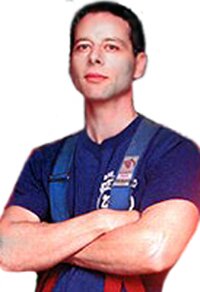
Firefighter Combat Challenge Drill
Captain Mike will be holding a Firefighter Fitness Workshop prior to the Firefighter Combat Challenge in Asheville, NC on May 22, 2008. Come one, come all to this much needed symposium on firefighter training protocols. To attend this event: >> REGISTER NOW
The Firefighter Combat Challenge is held around the country in many regional events. Thousand of spectators witness the best of the bravest, in full bunker gear and breathing apparatus performing the physical demands of real-life firefighting in a linked series of five tasks: climbing the five-story tower, hoisting, chopping, dragging hoses and rescuing a life-sized, 175-lb. "victim" as they race against time and their opponents.
The event inspires many smoke eaters to a higher level of physical conditioning. Unfortunately, those who need to be inspired most, rarely hear the call.
Many of America's firefighters are not up to the standard of passing CPAT, never mind the Combat Challenge. There is resistance within the ranks to embrace physical conditioning programs because of general laziness and fear of reprisal. Both union and management see only the risk and expense, but not the long term benefit, reduction of risk, and saving of millions in health care and workmen's comp costs.
The Challenge helps bring the concept of the fit firefighter to the forefront, for all to see. Getting the boys out of the back room and into the weight room is the clear message. With that in mind, I'd like to offer a training program, designed to improve abilities and work capacity, within the five events featured in the Challenge.
Firefighter-Specific STS and Kettlebell Lifting
The Challenge, much like actual fire operations, are sequentially linked events. We don't get to take that break no matter how bad we need it. Our approach to training is exactly the same, but with much tighter control.
STS, Sequenced Timed Sets, and my brand of kettlebell training are spot on matches to what firefighters do every day, without the luxury of dropping the weight, or hoseline, when fatigue hits. In this article, I'll provide you with a relatively simple STS style program, primarily focused on the skills displayed during the combat challenge. Okay, without any further ado, here's the routine.
COMBAT CHALLENGE DRILL
· Squat Thrust & Push Up Combo /goal 20 reps
· One Arm Dumbbell Push Press /goal 20 reps each arm
· Body Weight, Sandbag Squat /goal 20 reps
· Rope Pull /goal 20 reps*
· Sledge Hammer Swing /goal 20 reps each arm
· Tire Drag /goal 20 reps
· Run / Walk / Stair Climb
Perform all exercises in the order listed. Attempt to hit the goal rep on each move before adding reps. Rest as long as you need between sets, but attempt to reduce that rest time on future attempts. Keep resistance low and wear a weighted vest with cation. Do supplementary cardio and stair climbing to round out the program. Be sure you see your physician before starting and vigorous exercise plan. -ms
Now for some elaboration on each movement...
SQUAT THRUST PUSH UP COMBO
The Squat Thrust is a traditional academy movements that gets your whole body into it. When done with a Push Up between every Squat Thrust rep, it can get truly challenging. Proceed slowly, and you'll note that all reps are listed as goal reps. Only do as many reps as you can, rest, finish off your reps, move on. Eventually perform all reps called for without rest.
PUSH PRESS
The Push Press is simple to describe, sometimes hard to execute, but with practice you'll get it. Bring one dumbbell to your shoulder level. It should be relatively light, something you can press for about 20 times. Later, when you figure out how to move, you can work heavier. Remember, this is more about reps, not heavy weight.
While holding the dumbbell at shoulder level, allow your arm to relax against your body and elbow sink into your hip as much as possible. Your knees should be straight, hips slightly forward. With a quick short and sharp dip of the knees (not a deep squat), followed immediately by a quick pop up, press the bell. Allow the arm to travel upward in a straight line with as little upper body effort as possible. Get your legs and hips into the drive up. The bell should be held at the top position with elbow locked out. There should be a brief pause at lockout, a moment where you just hold it, however briefly, before allowing it to drop back down to it's starting position (arm and elbow against body, bell at shoulder level, hips slightly forward, knees straight, body relaxed).
SQUAT
Squats are performed with the butt back and down with the weight mostly on the heels, squatting as deeply as possible. After the short, sharp pops of the Push Press, the full range of motion should feel good. A vest can be donned, sandbag thrown over the shoulders, or even hold dumbbells as a way to increase intensity, but keep resistance generally light, as this is not about bulking up your legs.
ROPE PULL
Rope pulling requires a wide open space (preferably outdoors), the largest diameter rope you can get, and either an old duffel bag or truck tire (hold onto that truck tire for the next exercise). Securely attach your rope to the duffel bag or tire. One arm's length, or the length a full pull is about three feet. For 20 reps, you'll need about sixty feet, or repeat with the distance you do have for as many times as necessary to reach 20 pulls.
You'll also need to weigh down the tire or duffel bag with a sandbags or dumbbells or weight plates to create some resistance. Pulling can be performed standing, or down on one knee. A weight vest can be worn during the entire event. Count each full length arm pull as a single rep.
MAUL SWING
An eight pound sledge hammer or maul can be converted to a handy strength/endurance builder. All over the country non-firefighters use this as a conditioning tool. A large truck tire, off the rim, is a great tool to absorb impact of every swing. Set the tire on the ground in front of you. Either square off and face the target or assume a side boxer's stance. Fix your non dominant hand at the bottom of the tool's handle. This hand doesn't not move, and is considered fixed. Place your dominant hand about three quarters of the way up the handle, this is your slide hand. Prepare to swing in your natural style but be aware of your entire body.
Take a few soft swings and get the timing of the arms and legs together. Inhale as the head of the tool rises and sharply exhale as you swing down onto the side panel of the tire, allowing your lower body to drop down, adding force to your swing. Your slide hand travels quickly down the tool handle. Go at a nice even pace, no full cut swings until you're comfortable with the process.
For CPAT or forcible entry practice, place the tire up on a wooden table and take a sideways stance. Both hands remain fixed (same intitial positioning). Use the twist from your hips and weight transfer from back to front leg to generate force. For accuracy sake, hand do not slide when forcing entry. Short, sharp blows, generated from the hips can be used for high accuracy and in very close quarters. Count each blow on the tire as one rep. Again, the weighted vest is an option.
TIRE DRAG
Dragging a weighted down tire around your backyard isn't glorious, but it works. If you've got a large gym floor, you can also resort to our faithful duffel bag. Tire a large loop in your rope and around the tire. You can drag either facing away from the tire (mule style), or facing the tire (dummy drag style). Count every ten feet you pull the tire as one rep. For example, dragging a total of 200 feet would be 20 reps. Vest usage, as always, is optional.
RUN / WALK / STAIRS
Some guidance here... Don't literally, run yourself into the ground. You'll get the most out of the first couple of miles as far as the health and fitness goes. If you love to run and your body embraces it, by all means, excel. Otherwise stick with three days per week at 20 or 30 minutes. For the challenge you can do some work with the weighted vest, but never running. Walking and stair climbing, with near zero impact, are ideal. We don't run in full gear. If working vested stairs, keep times reasonable, starting out with five minutes and not more than 25 pounds on your vest.
FIREFIGHTER PROGRAMS
For a program that features full instruction on the above movements, along with online videos, please vist: firefighter classic program. For more information on training options, fill out the simple form at left, or send an email directly to me, Mike Stefano, at: michael.stefano@gmail.com. For a look at our full program directory: click here
FIREFIGHTER KETTLEBELL TRAINING
Captain Mike is also the American Kettlebell Club's Fire / Resuce Advisor, a position he takes very seriously. As a kettlebell coach, Mike incorporates true kettlebell lifting technique, as learned from Valery Fedorenko (world kettlebell lifting champion), to build extreme strength and endurance with his firefighter clients. For more information go to: >> Firefighter Kettlebell Training